Hibernation dyeing …

I can’t believe that it’s two months since I last posted something on my blog.  My excuse is that I hate cold weather and I have a tendency to hibernate over winter, only venturing forth on nice sunny days to prune something before scurrying back to the fire.

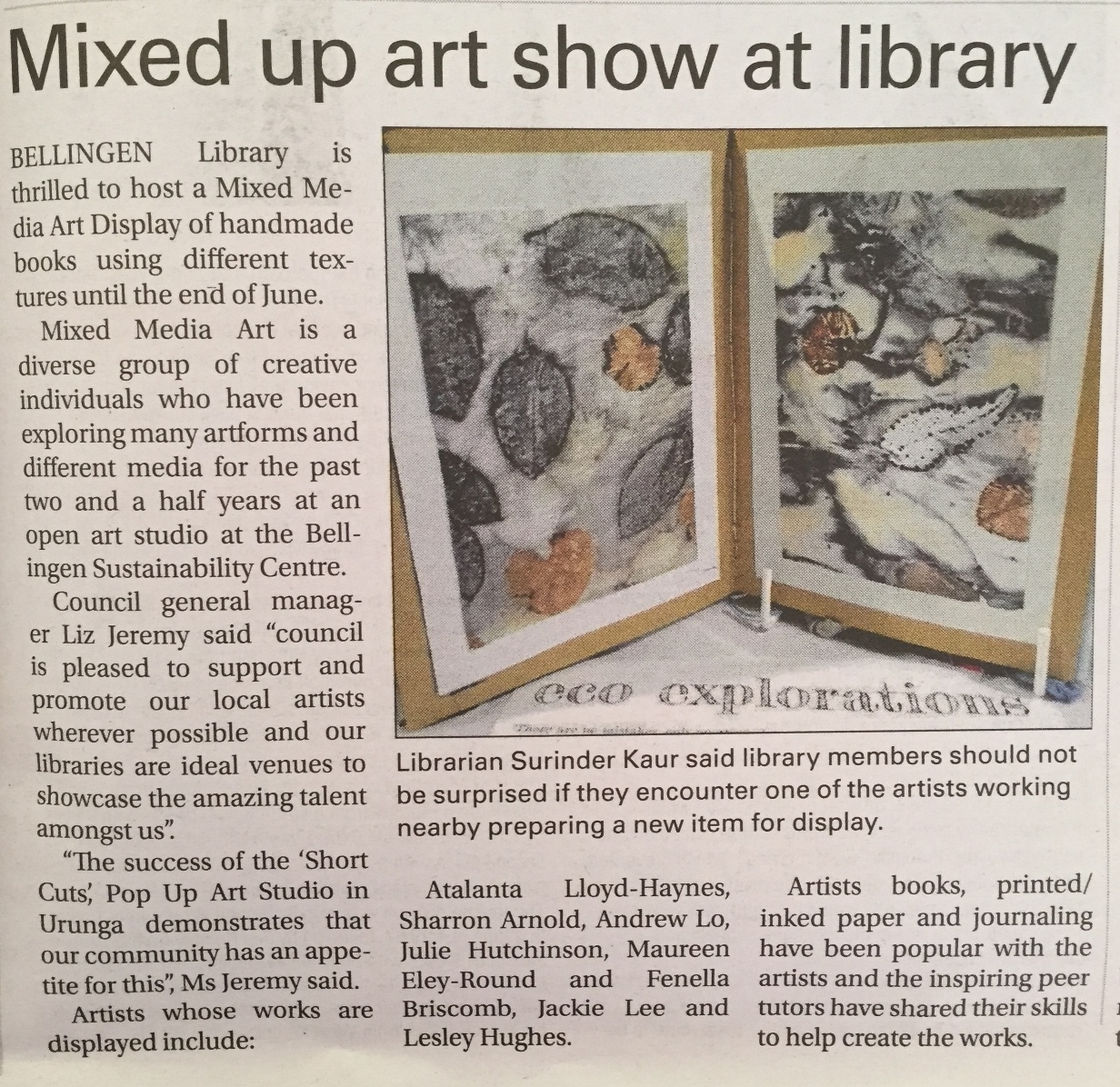
Winter hasn’t been entirely unproductive though.  Two of my eco-dyed scarves won a prize at the Bellingen Agricultural Show. It’s not exactly the Sydney Show but who cares!

I made up an “artist’s book” of my paper and fabric dyeing successes (and failures)  for display at our local library…
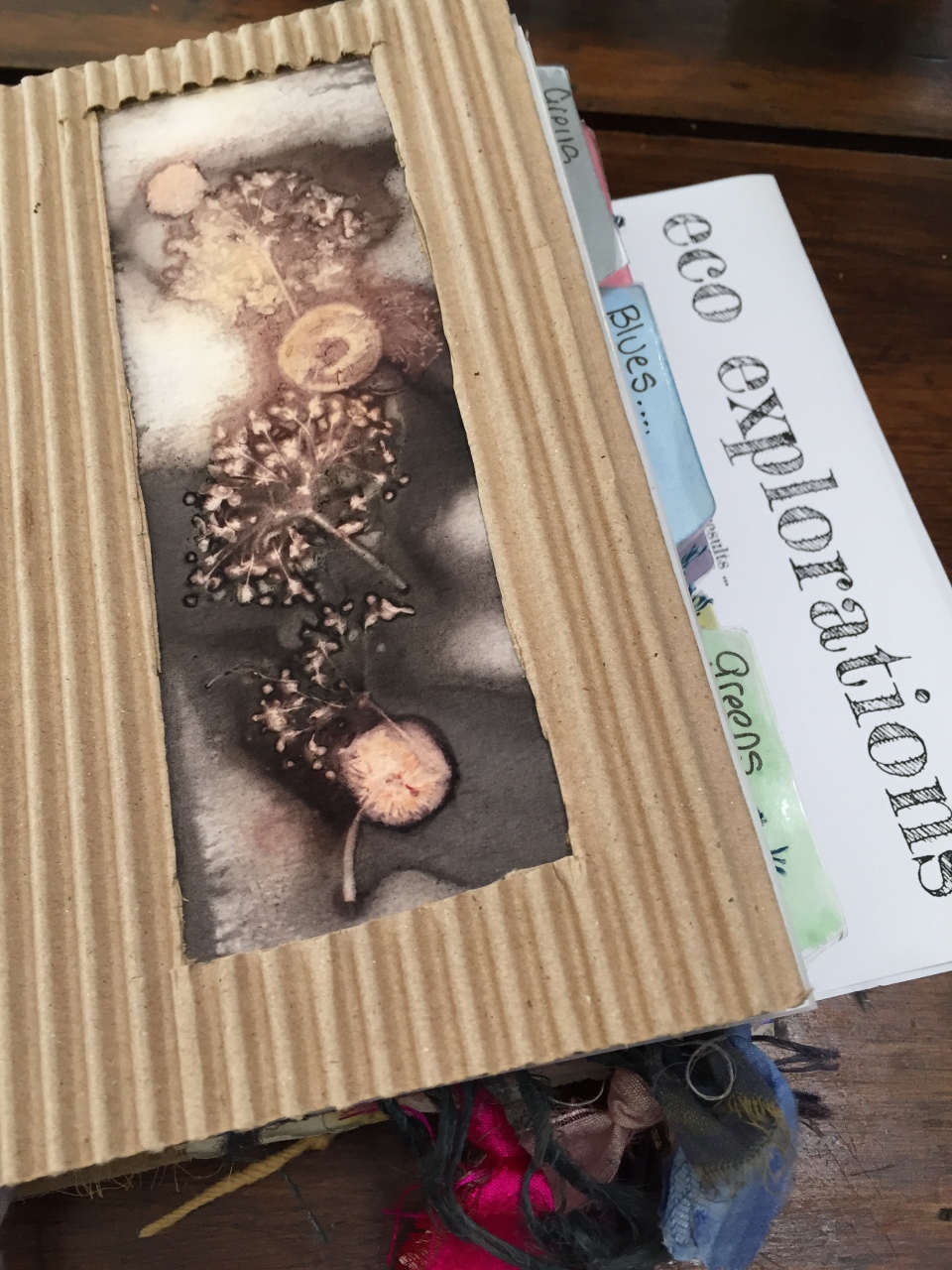
The display was mounted by the Mixed Up Art group as part of Readers & Writers week. The group held a bookbinding workshop in May, and whilst my bookbinding/sewing skills would benefit from some (a lot) more practice, the book held together and much to my surprise was featured in our local paper.

On rainy days, I have been experimenting with leaves gathered from the garden and on my morning walks.  Some leaves were disappointing – yielding absolutely no colour – but others such as Ornamental Maple and Native Tulipwood rewarded me with soft silhouettes, Geranium varied leaf by leaf, steamed Purple Carrot worked well,  but sometimes the bundle wrapping was more successful than the fabric piece.

The “compost experiment” failed primarily because I forgot about it.  By the time I dug it out of my compost heap, the bugs had munched on the silk and the bacteria had broken down the fibres.  Note to self: write a reminder in your diary!

One of my experiments using Native Tulipwood leaves on Habotai silk which was then dipped in a purple cabbage and iron bath – was particularly successful.  Depending on whether the cabbage is permanent or fugitive, this scarf may be a contender for next year’s Bellingen Show.  It’s all a bit of fun …


Black Sapote ice-cream …

Black Sapote Ice Cream (or Mousse)
(
read in conjunction with my previous post on harvesting Black Sapote)

Because Black Sapotes contain useful quantities of Vitamin C, Vitamin A, Potassium, Fibre, Calcium, Phosphorus and Iron and zero fat, they make a good base for a dessert. That is, until … you start adding naughty things.

This is an adaptable recipe depending upon your preference for yoghurt, sugar and flavourings. If you don’t have enough Black Sapote flesh, you can bulk it up with very ripe banana.  If you don’t want to use coconut sugar, you can use another sugar.  You virtually can’t go wrong.

Basic Ingredients

220 ml/1cup yoghurt of your choice
220 ml/1 cup of ripe sapote pulp (15-20 fruit depending upon size)
50-100 g coconut sugar – or sugar of your choice
30g good quality cocoa or cacao powder
1 tsp cinnamon
½  tsp nutmeg

Scoop out the seeds and the pith from the middle of the sapote. Discard. Then scoop out the flesh making sure you don’t include any skin, and purée in a food processor until completely smooth.

Add the yoghurt, sugar, cocoa, cinnamon and nutmeg and process again until completely combined. (you can add a ripe banana here if you like)

Taste and adjust sugar – remembering that freezing intensifies the flavour.

Place in the fridge to chill for about 30 minutes, and to allow the sugar to dissolve.

Process in your ice-cream maker for 10-20 minutes according to directions. If you don’t have an ice-cream maker you can just eat it like a mousse.  It’s delicious either way.

And here are a couple of other flavour ideas:

  • Add a shot of espresso and/or a shot of your favourite liqueur right at the end of churning. Don’t add it at the beginning or the alcohol will stop the mixture from freezing. I added Frangelico which is my favourite liqueur.
  • Add a ripe banana to the sapote pulp when processing.
  • Add some home-made shredded mandarin or cumquats in syrup. There are plenty of recipes on the internet

My Freycinet experience …

Last week I repeated a walk I did in Tasmania twenty years ago and strangely … it seemed a lot harder this time.  It’s probably fair to say that I slightly over-estimated my fitness level, and under-estimated my age!  Nevertheless, I made it to the last day, and managed to eat everything that was put in front of me (and a few things that weren’t).

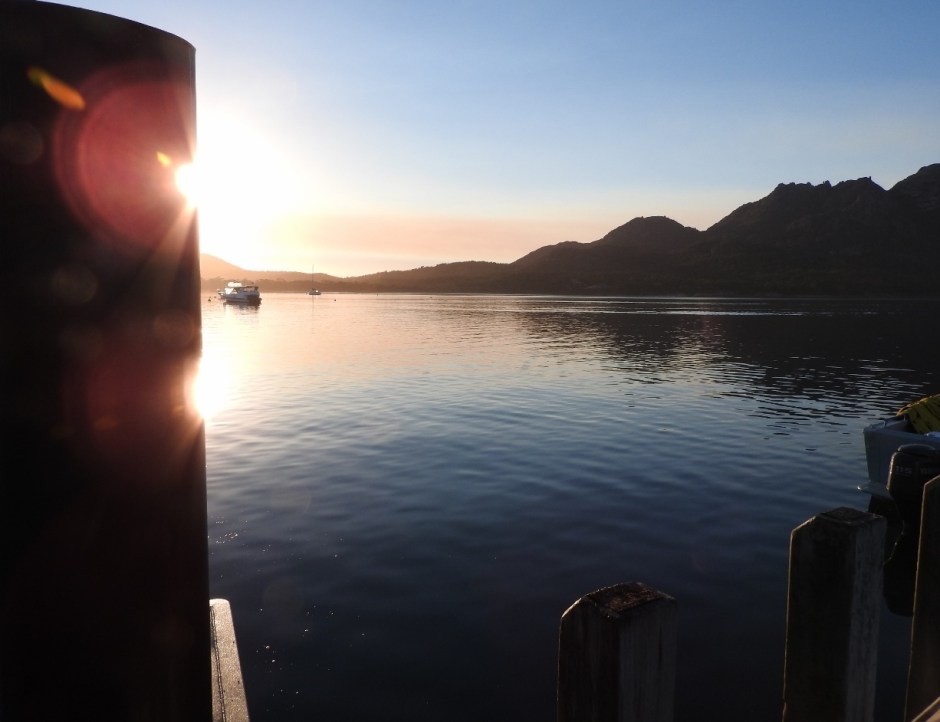
Looking fresh at the beginning of the day in Bluestone Bay

The Freycinet Peninsula is one of Tasmania’s most beautiful spots, and once you get away from the usual trails and into the bush, solitude, wildlife and deserted beaches abound. Guides Nick and Sarah were very knowledgeable which greatly enriched our experience, and for the benefit of the foreigners amongst the group, we “enriched” it even further with tales of venomous snakes, spiders, ticks, leeches, sharks and other endearing Australian creatures.

I walked for four days with Freycinet Experience Walk.  Each day we were taken by vehicle or boat to a remote spot, to walk back to our comfortable eco-lodge – the only lodge within Freycinet National Park. Hidden in the sand dunes behind Friendly Beaches, the lodge with its comfy lounges, well-stocked library and indigenous art was a welcome sight at the end of each day.

Near the end of Day Two – OMG!

Somehow, the wonderful Gemma and Dan managed to produce fresh tasty food every day, even catering dairy-free, gluten-free, no red meat and vegetarian.  Unfortunately, I eat everything, and it was the thought of their food that kept me going on days two and three …

Next on my walking list will be something a little less strenuous, perhaps Bruny Island?

World’s Smallest Bananas ?

Bananas (and Paw Paws) are gross feeders and drinkers, so if you’ve got a boggy spot in your garden, they are the perfect thing to plant. However, when the rain stops and the town goes on to Level 3 water restrictions – you have a problem.

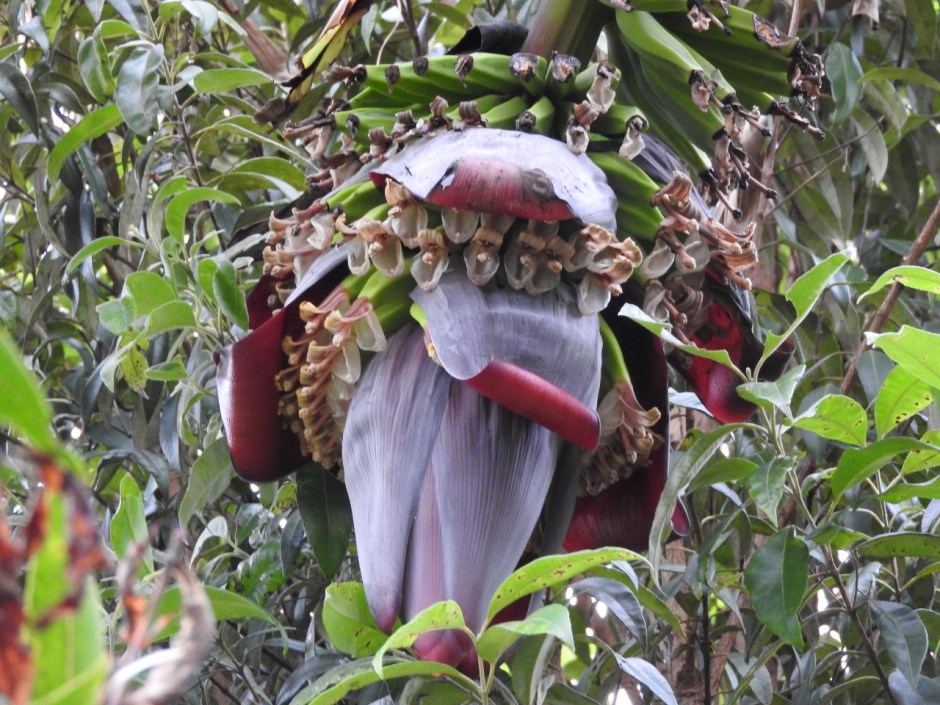
My Musa Pisang Ceylon banana, fruiting for the first time this year, started spring with the most magnificent inflorescence I have ever seen, and I was hopeful of a bounteous crop. But a hot gusty wind bent the already dehydrated trunk over and my hopes were dashed.  I ended up with hands of what might be the world’s smallest bananas.

musa-pisang-bananas
Musa Pisang Ceylon inflorescence

I was quite surprised when one by one they started ripening, and they turned out to be the sweetest bananas I had ever tasted. Not wanting to waste them, I revisited one of my old posts from back in “the dreamtime” when we used to have regular floods and rainfall of between 1,500 and 3,000 mm per annum!

The banana bread recipe I linked to my old post no longer exists, so here is a link to my recipe which I have modified slightly to reduce the rather horrifying sugar content of the original. Still just as nice and with a rich caramel taste.

banana-bread-coolingbanana-bread-testing